Open Robotics

Powering the world's robots

Blog

Gary Servín (Ekumen): ROS android_ndk: What? Why? How?

February 19, 2016 by Steffi Paepcke

What’s ROS android_ndk? Why should you care? How does it work? Gary Servín is with Ekumen, an engineering and software consulting company based in Buenos Aires, Argentina that specializes in ROS, web and Android development. With the backing of Qualcomm and OSRF, Ekumen has been trying to make it both possible and easy to run ROS applications on small Android devices like tablets and cellphones using Android’s native language development kit.

As Gary explains, the increasing performance, decreasing cost, and overall ubiquity of Android devices make them ideal brains for robots. The tricky part is getting ROS packages to play nice with Android, which is where ROS android_ndk comes in: it’s a set of scripts that Ekumen is working on to make the process much easier. Unlike rosjava, ROS android_ndk gives you access to 181 packages from the desktop variant of ROS, with the ability to run native ROS nodes directly.

Ekumen is actively working on this project, with plans to incorporate wrappers for rosjava, actionlib implementation, and support for ROS 2. In the meantime, there’s already a set of tutorials on ROS.org that should help you get started.

ROSCon 2015 Hamburg: Day 1 – Gary Servin: ROS android_ndk: What? Why? How? from OSRF on Vimeo.

Next up: Lorenz Meier & Roman Bapst of ETH Zurich and PX4
Check out last week’s post: Stefan Kohlbrecher of Technische Universitaet Darmstadt

Filed Under: Blog Posts

Stefan Kohlbrecher (Technische Universitaet Darmstadt): An Introduction to Team ViGIR’s Open Source Software and DRC Post Mortem

February 12, 2016 by Steffi Paepcke

Stefan’s early research using tiny soccer-playing humanoid robots at Technische Universität Darmstadt in Germany prepared him well for software development on much larger humanoid robots that don’t play soccer at all. From the Darmstadt Dribblers RoboCup team to the DARPA Robotics Challenge Team ViGIR, Stefan has years of experience with robots that need to walk on two legs and do things while not falling over (much).

Almost all of the software that Team ViGIR used to control its ATLAS robot (named Florian) was ROS based. Stefan credits both the team’s prior experience with ROS, ROS’s existing software base, and its vibrant community for why Team ViGIR made the choice to go with ROS from the very beginning. Controlling the ATLAS robot is exceedingly complex, and Stefan takes us through the software infrastructure that Team ViGIR used during the DRC; from basic perception to motion planning to manipulation and user interfaces.

With lots of pictures and behind-the-scenes videos, Stefan describes how Team ViGIR planned to tackle the challenging DRC Finals course. The team used both high-level autonomy and low-level control, with an emphasis on dynamic, flexible collaboration between robot and operator. Stefan narrates footage of both of Florian’s runs at the DRC Finals; each was eventful, but we won’t spoil it for you.

To wrap up his talk, Stefan describes some of the lessons that Team ViGIR learned through their DRC experience: about ROS, about ridiculously complex humanoid robots, and about participating in a global robotics competition.

ROSCon 2015 Hamburg: Day 1 – Stefan Kohlbrecher: An Introduction to Team ViGIR’s Open Source Software and DRC Post Mortem from OSRF on Vimeo.

Next up: Gary Servin of Creativa77
Check out last week’s post: Mark Shuttleworth of Canonical

Filed Under: Blog Posts

Mark Shuttleworth (Canonical): Commercial Models for the Robot Generation

February 5, 2016 by Steffi Paepcke

In 2004, Canonical released the first version of Ubuntu, a Debian-based open source Linux OS that provides one of the main operational foundations of ROS. Canonical’s founder, Mark Shuttleworth, was CEO of the company until 2009, when he transitioned to a leadership role that lets him focus more on product design and partnerships. In 2002, Mark spent eight days aboard the International Space Station, but that was before the ISS was home to a ROS-powered robot. He currently lives on the Isle of Man with 18 ducks and an occasional sheep. Ubuntu was a platinum co-sponsor of ROSCon 2015, and Mark gave the opening keynote on developing a business in the robot age.

Changes in society and business are both driven by changes in technology, Mark says, encouraging those developing technologies to consider the larger consequences that their work will have, and how those consequences will result in more opportunities. Shuttleworth suggests that robotics developers really need two things at this point: a robust Internet of Things infrastructure, followed by the addition of dynamic mobility that robots represent. However, software is a much more realistic business proposition for a robotics startup, especially if you leverage open source to create a developer community around your product and let others innovate through what you’ve built.

To illustrate this principle, Mark shows a live demo of a hexapod called Erle-Spider, along with a robust, high-level ‘meta’ build and packaging tool called Snapcraft. Snapcraft makes it easy for users to install software and for developers to structure and distribute it without having to worry about conflicts or inter-app security. The immediate future promises opportunities for robotics in entertainment and education, Mark says, especially if hardware, ROS, and an app-like economy can come together to give developers easy, reliable ways to bring their creations to market.

ROSCon 2015 Hamburg: Day 1 – Mark Shuttleworth: Commercial models for the robot generation from OSRF on Vimeo.

Next up: Stefan Kohlbrecher of Technische Universitaet Darmstadt
Check out last week’s post: OSRF’s Brian Gerkey

Filed Under: Blog Posts

ROSCon Program Video – Brian Gerkey

January 29, 2016 by Steffi Paepcke

ROSCon is an annual conference focused on ROS, the Robot Operating System. Every year, hundreds of ROS developers of all skill levels and backgrounds, from industry to academia, come together to teach, learn, and show off their latest projects. ROSCon 2015 was held in Hamburg, Germany. Beginning today and each week thereafter, we’ll be highlighting one of the talks presented at ROSCon 2015.

Brian Gerkey (OSRF): Opening Remarks

Brian Gerkey is the CEO of the Open Source Robotics Foundation, which oversees core ROS development and helps to coordinate the efforts of the ROS community. Brian helped found OSRF in 2012, after directing open source development at Willow Garage.

Unless you’d like to re-live the ROSCon Logistics Experience, you can skip to 5:10 in Brian’s opening remarks, where he provides an overview of ROSCon attendees and ROS user metrics that shows how diverse the ROS community has become. Brian touches on what’s happened with ROS over the last year, along with the future of ROS and OSRF, and what we have to look forward to in 2016. Brian also touches on DARPA’s Robotics Fast Track program, which has a submission deadline of January 31, 2016.

ROSCon 2015 Hamburg: Day 1 – Opening Remarks from OSRF on Vimeo.

Next up, Mark Shuttleworth from Canonical.

Filed Under: Blog Posts

Looking Forward to the Robot Economy

November 30, 2015 by Steffi Paepcke

OSRF CEO, Brian Gerkey, was recently asked to contribute his thoughts as part of O’Reilly Media’s recent Next: Economy Summit. Called “WTF”, the event tackled the issues of how work, business and society face massive technology-driven change. His contribution was entitled: “Looking Forward to the Robot Economy”. Check out the excerpt, below.

Let’s talk about robots. In the near future, robots will learn how to do more and more of the things that we humans are used to doing ourselves. Watching the progress of robotic technology over the last several years has caused a wild and so far mostly theoretical economic panic about the future of humans in the workplace. But despite the flood of articles suggesting that the human worker is doomed, robots are almost certainly not going to take your job anytime soon.

The complete post is here.

Filed Under: Blog Posts

Join Us for DARPA’s Robotics Fast Track West Coast Tour, Nov. 17-19

November 10, 2015 by Steffi Paepcke

RFT logo

Open Source Robotics Foundation is joining DARPA and Tandem National Security Innovations on the road to spread the word about DARPA’s Robotics Fast Track Program. We’re proud to support the opportunity for startups and roboticists to receive $150,000 to build a robot prototype.

Join us in Seattle, Redwood City, Livermore, San Diego (or all four!) to learn more about the innovative program designed to make it easier to get projects funded in weeks, not months or years by the Pentagon’s leading advanced research lab. Whether you’re a roboticist, technologist, or entrepreneur, you’ll want to join us for this rare opportunity. The events will begin with an informational session to discuss the program followed by the opportunity for attendees to meet privately with representatives from DARPA, OSRF and TandemNSI to ask specific questions about individual projects. Food and drink will be provided at each of our free events so come out and join us.

Seattle Event Details

Date/Time: Nov. 17, 2015 from 6:30 p.m. to 8:30 p.m.
Location: The Maker’s Space (92 Lenora Street, Seattle, WA 98121)
Register Here

Northern California Event Details

Lunch in Livermore
Date/Time: Nov. 18, 2015 from 11:30 a.m. to 1 p.m.
Location: i-GATE Innovation Hub (2324 Second St, Livermore, CA 94550)
Register Here

Evening in Redwood City
Date/Time: Nov. 18, 2015 from 6:30 p.m. to 8:30 p.m.
Location: TechShop Mid Peninsula (2415 Bay Road, Redwood City, CA 94063)
Register Here

San Diego Event Details

Date/Time: Nov. 19, 2015 from 6:30 p.m. to 8:30 p.m.
Location: The Basement — UC San Diego (9500 Gilman Dr., La Jolla, CA 92093)
Register Here

To learn even more about the program, the Robotics Fast Track website has specifics on how to apply, and more details on the technologies that DARPA seeks. We look forward to seeing you at one of the West Coast events!

Filed Under: Blog Posts

Happy Halloween!

October 30, 2015 by Steffi Paepcke

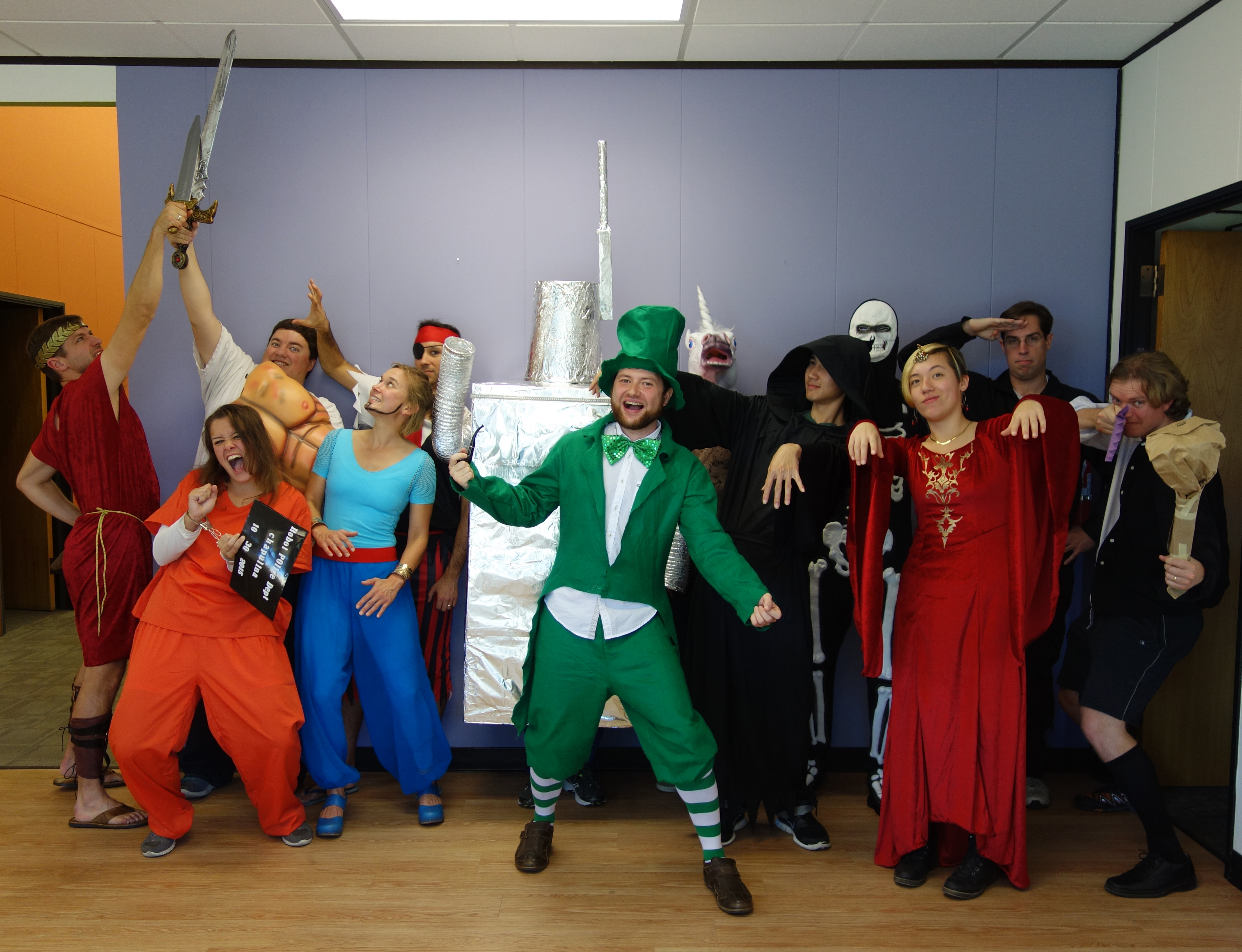
OSRF in costume
Happy Halloween from OSRF! Our commitment to wearing costumes at work is as strong as our commitment to open source software!

Filed Under: Blog Posts

Tune in to ROSCon 2015, Oct. 3-4

September 30, 2015 by Steffi Paepcke

ROSCon 2015 logo

This year’s ROSCon is nearly upon us. If you haven’t yet made plans to get yourself to Hamburg, then you are out of luck as this year’s ROSCon has sold out. The good news is that we are live streaming ROSCon presentations free of charge, courtesy of Qualcomm.

Click here for the live stream beginning 9:00 a.m. CEST, 2015, 12:00 a.m. PDT or 3:00 a.m. EDT on October 3, 2015.

All sessions will also be recorded and made available for viewing in the near future. Follow @OSRFoundation for announcements about their availability.

A final thank you to Platinum Sponsors Fetch Robotics and Ubuntu; Gold Sponsors 3D Robotics, Bosch, Clearpath Robotics, GaiTech, Magazino, NVIDIA, Qualcomm, Rethink Robotics, Robotis, Robotnik, ROS-Industrial, Shadow Robot Company, SICK and Synapticon; and Silver Sponsors Erle Robotics and Northwestern University, McCormick School of Engineering.

Check out the program here.

If you’re attending in-person, we look forward to seeing you soon!

Filed Under: Blog Posts

Gazebo Rendering Abstraction

September 29, 2015 by Ian Chen

During his internship with OSRF, Mike Kasper developed a new ignition-robotics rendering library. The key feature of this library is that it provides an abstract render-engine interface for building and rendering scenes. This allows the library to employ multiple underlying render engines. The motivation for this work was to extend Gazebo’s rendering capabilities to provide near photo-realistic imagery for simulated camera sensors. This could then be utilized for the development and testing of perceptions algorithms.

As Gazebo currently employs the Object-Oriented Graphics Rendering Engine (OGRE), an OGRE-based implementation has been added to the ignition-rendering library. Additionally, a render-engine using NVIDIA’s OptiX ray-tracing engine has also been implemented. The current OptiX-based render-engine employs simple ray-tracing techniques, but will employ physically based path-tracing techniques in the future to generate photo-realistic imagery.

The following videos give an overview of the libraries’ current capabilities:

Source code for the ignition-rendering library is available here:
https://bitbucket.org/ignitionrobotics/ign-rendering

Filed Under: Blog Posts

ROS & Gazebo at the DRC Finals

June 9, 2015 by Brian Gerkey

DRC Finals logo
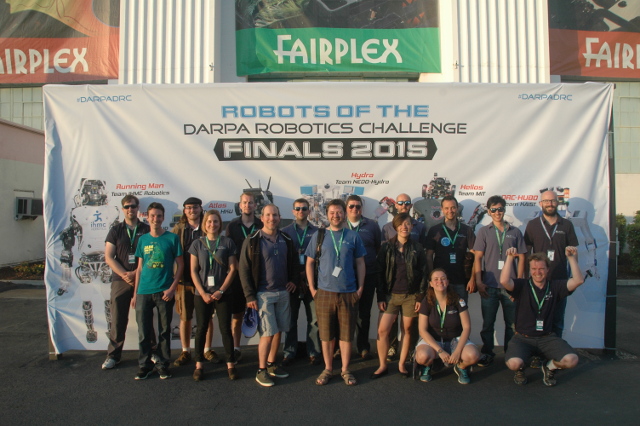
OSRF has been intimately involved in the DARPA Robotics Challenge (DRC) from the beginning in June 2012, when we started getting Gazebo into shape to meet the simulation needs of DRC teams, including hosting the Virtual Robotics Challenge (VRC) in June 2013. So the DRC Finals this past weekend was a special event for us, representing three years of work from our team.

We were especially excited to see widespread use of both ROS and Gazebo during the two-day competition. Walking through the team garage area during the finals, we saw many screens showing rviz and other ROS tools, and even one with a browser open to ROS Answers (some last-minute debugging, we assume).

We talked with several teams who used Gazebo in their software development and testing, including teams using robots other than the Atlas that we modeled for the VRC. In the post-DRC workshop on Sunday, both first-place Team KAIST and third-place Tartan Rescue discussed their use of Gazebo, in particular for developing solutions to fall-recovery and vehicle egress. That’s one of the reasons we work on Gazebo: to give roboticists the tools they need to safely develop robot software to handle unsafe situations, without risk to people or hardware.

Based on our observations at the competition and communications with team members, out of the 23 DRC Finals teams, we count 18 teams using ROS and 14 teams using Gazebo. We couldn’t be happier to see such impact from open source robot software!

Filed Under: Blog Posts

  • « Previous Page
  • 1
  • 2
  • 3
  • 4
  • 5
  • 6
  • …
  • 17
  • Next Page »

Tweets by Open Robotics

Tweets by @OSRFoundation

Copyright © 2019 · Open Source Robotics Foundation, Inc.. All Rights Reserved.