Open Robotics

Powering the world's robots

Blog

OSRF welcomes Carlos Aguero

January 22, 2013 by Brian Gerkey

OSRF is pleased to welcome Carlos Agüero! Carlos received his Ph.D. and M.S. from Universidad Rey Juan Carlos in Computer Science, under the supervision of Dr. José M. Cañas and Dr. Vicente Matellán. Carlos is a Robotics enthusiast, and the multidisciplinary aspects of robotics and the challenges faced by real robotics projects have sculpted his formation and career. Ad hoc networks for mobile robots were the target of his early days of research. He designed and developed an autonomous system for detecting overtaking maneuvers applied to trucks. Carlos’s research has been focused on multi-robot object localization, task allocation and multi-target object localization. He has been a proud RoboCuper since 2005 and is a co-founder of Spiteam, the RoboCup Standard Platform League team. He co-developed a complete robot architecture (Behaviour-based Iterative Control Architecture, BICA) from scratch for the Nao robot applied to robot soccer and Alzheimer therapy.

Before joining OSRF, Carlos held a faculty position in the GSyC department at Universidad Rey Juan Carlos and was Director of the Telematics and Computer Systems Master program. In 2010 and 2011, he visited the Artificial Intelligence Laboratory at the University of Texas at Austin, and CORAL Research group at Carnegie Mellon University.

Filed Under: Blog Posts

ROS/Android hackathon

January 22, 2013 by Brian Gerkey

On January 16th, OSRF hosted a full-day hackathon on ROS/Android. We were very happy to have folks from Willow (Austin, Tully, and Chad) Yujin (Daniel, Jihoon, and Huey) and Google (Damon). From OSRF, Hugo, Stephen, Ian, Brian, Kazuto, and Morgan took part. And Ken stopped by (with Ninja, of course).

The day was a great success. There’s really nothing like getting everybody in the same room for a day. We worked through a bunch of issues on workflow and build process, we ported some existing apps to the newest libraries, and we wrote some new apps. All of our work is available at github, in the rosjava and ros-android organizations. Please have a look and contribute if you can!

We were so busy during the day that we didn’t get many pictures. Jihoon took the following two shots in the morning while we were planning the day:

Filed Under: Blog Posts

OSRF welcomes Jose Luis Rivero

January 22, 2013 by Brian Gerkey

OSRF is pleased to welcome Jose Luis Rivero! Jose Luis is a Computer Engineer from the Carlos III University of Madrid. During his university times he was tempted by compilers and customized binaries and joined the Gentoo Linux project as developer for 6 years. Jose Luis moved from Madrid to Barcelona to finish his studies at UPC University. There he started work in the Institut de Robòtica i Informàtica Industrial (IRI). Being an open source enthusiast, and together with his colleagues Guillem Alenyà and Sergi Hernandez, Jose Luis began The Humanoid Lab initiative, which brings robotics and open source projects to university students. In his last two years at IRI, Jose Luis worked with PhD students to improve software practices and encourage development of open source ROS code for mobile robotics and perception and manipulation. For Jose Luis, working at OSRF, producing robotics software following an open source philosophy, is a dream come true.

Filed Under: Blog Posts

OSRF welcomes Ian Chen

December 4, 2012 by Brian Gerkey

OSRF is pleased to welcome Ian Chen! Ian received a PhD in Electrical and Computer Engineering from the University of Auckland in 2011 under the supervision of Bruce MacDonald and Burkhard Wünsche. Ian spent his PhD investigating methods for improving the robot development cycle, particularly through the use of real time simulation and visualization. After a short interlude working as a software engineer on the open source Qt framework, Ian is excited to be back in the realm of robotics where he can continue his career in robot simulation and open source development at OSRF.

Filed Under: Blog Posts

ROS @ Five Years

December 4, 2012 by Brian Gerkey

[Cross-posted from the ROS blog]

ROS turned five years old in November, so it’s time for our sort-of-annual State of ROS. If you recall, we took a deep dive into the growth of ROS in our third-year anniversary post. We won’t be as prolific this time around, but suffice it to say that the past two years have built on the excitement, growth, and adoption of ROS.

Numbers don’t tell the entire story, but it’s a good place to start.

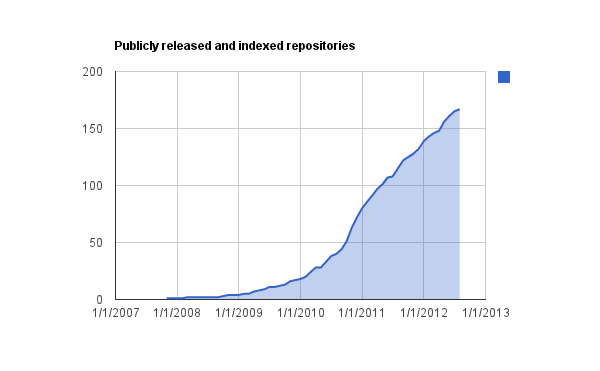
  • There are 175 organizations or individuals who have publicly release ROS software in our indexed repositories, up from 50 in 2009 (through October)
    ros_repositories_5_year.png
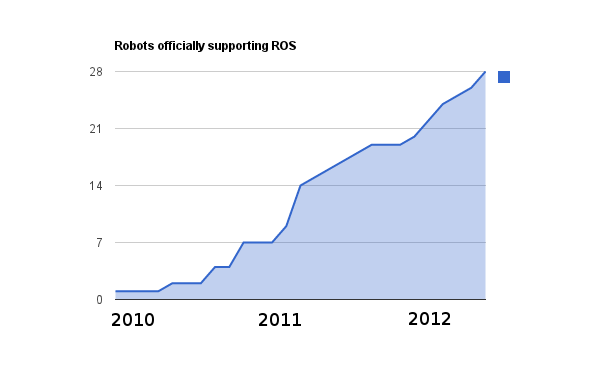
  • Not counting the approximately 40 PR2s all over the world, there are many hundreds of robots running ROS. We are aware of more than 90 types of robots that are running ROS, up from 50. With 28 robots with supported installation instructions.
    robots_5_year.png
  • We had 3699 public ROS packages as of April, compared to 1600 three years ago
  • ROS continues to have a strong impact in the worldwide academic community, with 439 citations on Google Scholar for the paper: ROS: an open-source Robot Operating System
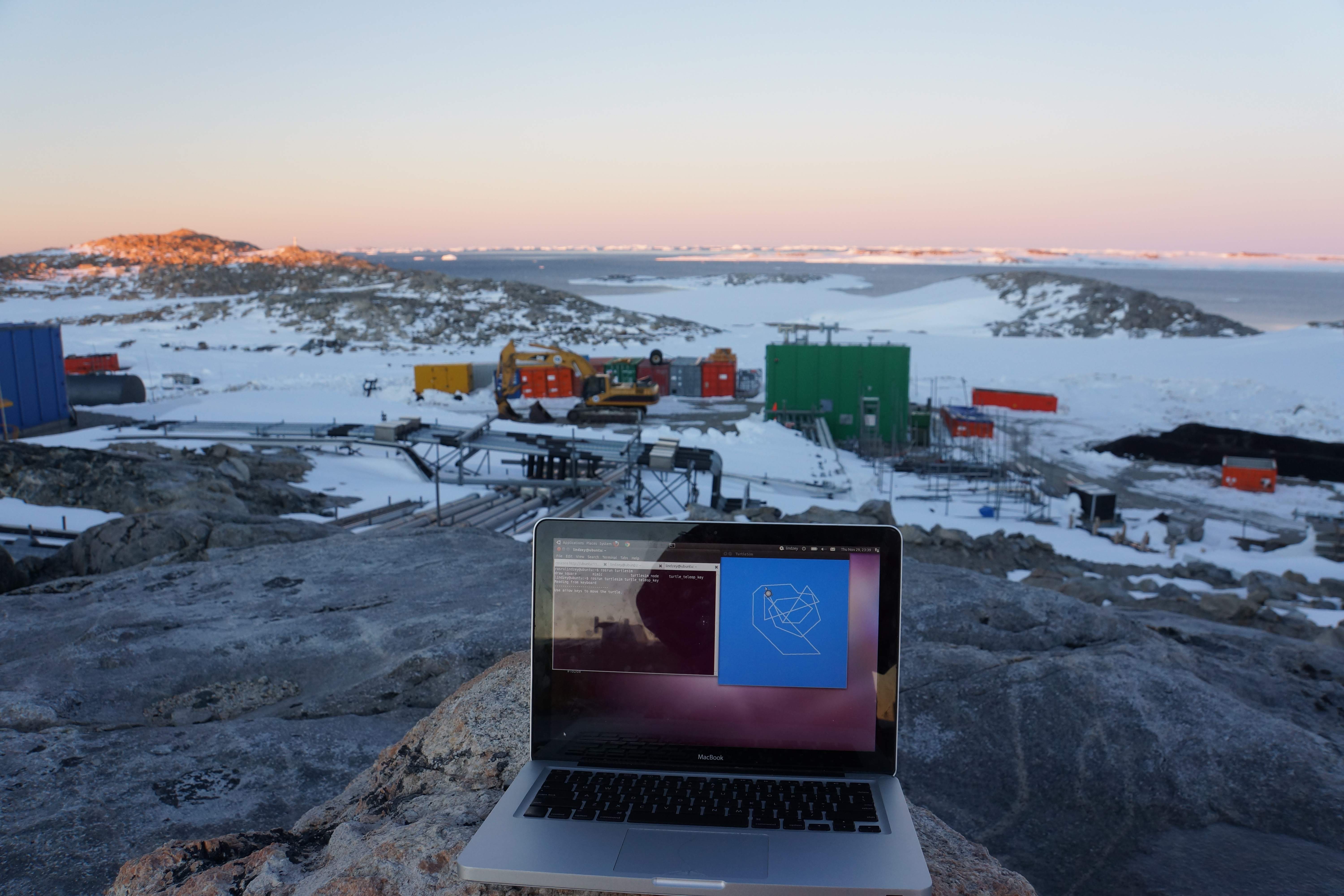
  • There are now people working on ROS on every continent. Africa, South America, and Antarctica are new to the community this time around. Yes, Antarctica.
    ROSAntarctica.jpg
  • You can now buy a book on ROS.
  • One, and counting. This is the number of industry conferences dedicated to ROS. More than 200 individuals attended the ROSCon 2012 debut last year in St. Paul, MN. ROSCon 2013 heads to Stuttgart, Germany next year.
  • People often ask how many users are there of ROS. Due to the open source nature of ROS, we simply don’t know how many ROS users there are in the world. What we can tell you is that the ros.org wiki has had over 55,000 unique visitors in the last month. This doesn’t include traffic to our many worldwide mirrors.

The latest version of ROS, Groovy Galapagos, is currently in Beta 1 Release. Groovy will be the sixth full release of ROS. This release is laying the foundations for enabling ROS to continue to grow the number of platforms supported.

Inspired by The Mozilla Foundation, The Apache Software Foundation, and The GNOME Foundation, our three-year anniversary blog post discussed the possibility of a ROS Foundation. In May of this year, Willow Garage announced the debut of the Open Source Robotics Foundation, Inc. OSRF is an independent non-profit organization founded by members of the global robotics community whose mission is to support the development, distribution, and adoption of open source software for use in robotics research, education, and product development.

Because of the BSD license for ROS, we often have no idea who is using ROS in their commercial deployments. We suspect there are a few we are missing, but two major new products were announced this year that are built using ROS. First is Baxter from Rethink Robotics. Baxter was announced just a few months ago and the company has set their sites on manufacturing industries. Check out IEEE Spectrum’s article on Rethink here. Also built on ROS is Toyota’s Human Support Robot (HSR), which is designed to help those with limited mobility within the home. ROS has even made inroads within the industrial robot world of late, specifically through the ROS-Industrial Consortium.

We can’t discuss commercial deployments of ROS without mentioning TurtleBot, originally released in April 2011. Recognizing that not everyone can afford, or even needs, a $280,000 PR2 robot, TurtleBot was brought to market for the express purpose of letting as many people as possible get their hands on ROS. TurtleBot 2.0 was recently featured on Engadget and is now available for pre-order at www.turtlebot.com.

At Willow Garage, we often refer to ourselves as a software company disguised as a robot company, and we can point to the ongoing growth of ROS as proof of that assertion. We have also been stating for some time that we need a LAMP stack for robotics. With the latest developments in commercial robots built on ROS, it feels like we are in the beginning stages of that process. We can’t predict what ROS will look like in five year, or twenty-five, but if we continue to see the adoption, innovation, and excitement from the ROS community that we have seen in the first five years, then things are certainly looking Rosey.

rosie_cbs.png

Filed Under: Blog Posts

ROSCon 2013: Call for Proposals

November 13, 2012 by Brian Gerkey

Call for Proposals: ROSCon 2013
Stuttgart, Germany
11-12 May 2013
(immediately following ICRA)

Details: http://roscon.ros.org/
Proposals: submit@roscon.ros.org
Questions: info@roscon.ros.org

ROSCon 2013 is a chance for ROS developers of all levels, beginner to expert, to spend an extraordinary weekend learning from and networking with the ROS community. Get tips and tricks from experts, network, and share ideas with fellow developers from around the globe.

ROSCon is a developers conference, in the model of PyCon and BoostCon. Following the success of the inaugural ROSCon in St. Paul, Minnesota, this year’s ROSCon will be held in Stuttgart, Germany. Similar to last year, the two-day program will comprise technical talks and tutorials that will introduce you to new tools and libraries, as well as teach you more about the ones you already know. The bulk of the program will be 30-40 minute presentations (some may be longer or shorter).

Want to present at ROSCon? Submit a proposal! For details on proposing, go to http://roscon.ros.org/

If you don’t want to make a formal presentation, you should still bring your new project or idea to ROSCon!

There will be sessions of Lightning Talks, which are 5-minute mini-talks that are scheduled just-in-time at the conference. There will also be open space for Birds-of-a-Feather (BoF) meetings, impromptu hacking sessions, and informal presentations.

On behalf of the ROSCon 2013 Organizing Committee:

  • Alexander Bubeck, Fraunhofer IPA
  • Tully Foote, Willow Garage
  • Ryan Gariepy, Clearpath Robotics
  • Brian Gerkey, Open Source Robotics Foundation
  • Florian Weisshardt, Fraunhofer IPA
  • Matthew Williamson, Rethink Robotics

Filed Under: Blog Posts

OSRF welcomes Steven Peters

November 9, 2012 by Brian Gerkey

OSRF is pleased to welcome Steven Peters! Steven recently defended his PhD thesis, “Optimal Planning and Control for Hazard Avoidance of Front-Wheel Steered Ground Vehicles,” in the MIT Mechanical Engineering Department. At OSRF, he will apply his experience with dynamics and control to physics simulation for robotic manipulators and vehicles. As a Northern California native, he is happy to be back home.

Filed Under: Blog Posts

OSRF goes to Washington

October 23, 2012 by Brian Gerkey

The OSRF offices will be quieter than usual this week as Brian, John, Nate, Steffi, and Morgan will be at DARPA headquarters in Washington, DC (well, Arlington, VA) for the three-day kickoff of the Robotics Challenge.

The highlight of our week will be a full-day tutorial on the recently released DRC Simulator that we’re teaching on Thursday. We’re expecting about 75 Challenge participants who are eager to learn about this first version of the DRC Simulator and we’re hoping to get feedback from them that can influence our future development plans.

Filed Under: Blog Posts

OSRF welcomes Jimmy Sastra

October 8, 2012 by Brian Gerkey

OSRF is pleased to welcome Jimmy Sastra!

He received his Ph.D. in Mechanical Engineering and Applied Mechanics from
the University of Pennsylvania in August 2011 under the supervision of Mark Yim. Working with Mark, Jimmy developed hardware and software for many generations of Modular Reconfigurable Robots. In his thesis work, he showed that these robots can be used to quickly prototype and analyze a variety of dynamic locomotion gaits from rolling like a wheel to running with compliant legs. They can even put themselves back together after they are kicked apart into separate pieces.

Prior to joining OSRF, he worked at Willow Garage, where he learned a number of things, including how to pull a good office prank.

Filed Under: Blog Posts

OSRF welcomes Hugo Boyer

October 5, 2012 by Brian Gerkey

OSRF is pleased to welcome Hugo Boyer! Hugo received a mechanical engineering degree from Ecole Polytechnique of Montreal and has been a professional developer for over 15 years. Recently, at Makerbot Industries, he created Miracle-Grue, Makerbot’s first tool path engine for 3D printers. Before that, he worked on parallel GPU algorithms for the computational chemistry lab at McGill University, and was an architect of SIMSAT, the real time spacecraft simulator of the European Space Agency. Hugo is honored to join the OSRF simulation team where he hopes to help make robot dreams come true.

Filed Under: Blog Posts

  • « Previous Page
  • 1
  • …
  • 13
  • 14
  • 15
  • 16
  • 17
  • Next Page »

Tweets by Open Robotics

Tweets by @OSRFoundation

Copyright © 2019 · Open Source Robotics Foundation, Inc.. All Rights Reserved.